Quick Answer: We found no published Georgia Power medical priority sign-up that guarantees faster repairs. Georgia rules do let seriously ill customers pause a shutoff for unpaid bills. Notify your utility, send a doctor’s statement within 10 days, and build your own backup power plan.
A storm hits at night, and your child’s ventilator switches to battery. Many Georgia parents then search for Georgia Power medical priority and hope one form solves the problem. This guide shows what that phrase really covers and how to build a safe power outage plan.
What You'll Learn
What Georgia Power medical priority really means
Which Georgia utilities follow the state shutoff rule
Seven steps to request shutoff protection
How to plan for a power outage with a ventilator
What to pack in an emergency go bag
What backup power may cost
What Georgia Power Medical Priority Really Means
People use the phrase Georgia Power medical priority to mean two different things. One is protection from a power shutoff. The other is faster repairs after an outage.
Protection from a shutoff for unpaid bills
Georgia Public Service Commission Rule 515-3-2-.03 covers residential customers with a serious illness. A shutoff for unpaid bills cannot go ahead if it would make that illness worse. You must follow set steps and deadlines to qualify.
Faster repairs after an outage
We found no published rule that promises this. Downed trees and damaged lines can slow any crew. Ask your utility exactly what it does for medical accounts.
Treat any account note as extra help. Your safety plan must still work if power stays off for days.
Not every Georgia utility follows the same rules
The state rule protects Georgia Power customers. ProPublica reported that it does not cover Georgia’s nearly 100 small electric utilities. Small utilities include city systems and electric membership corporations (EMCs).
InvestigativeTV reported that Georgia Power must give customers who depend on medical equipment an extra 30 days. Cities and EMCs face no such requirement. One city utility, Griffin Power, gave just one extra day.
House Bill 641 aims to set similar protections for every utility. A House committee approved it in February 2026. Check its current status before you rely on it.
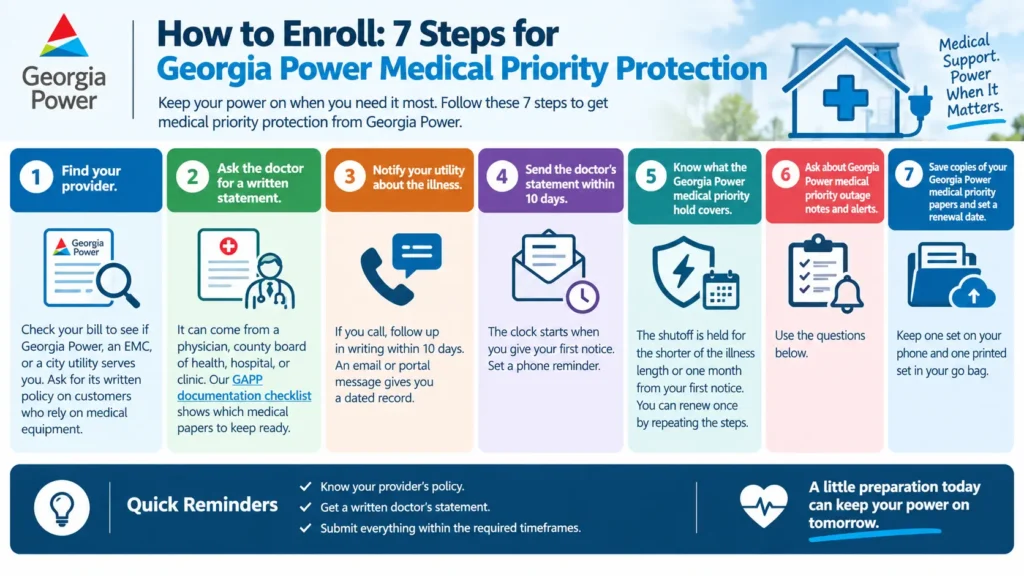
How to Enroll: 7 Steps for Georgia Power Medical Priority Protection
Find your provider. Check your bill to see if Georgia Power, an EMC, or a city utility serves you. Ask for its written policy on customers who rely on medical equipment.
Ask the doctor for a written statement. It can come from a physician, county board of health, hospital, or clinic. OurGAPP documentation checklist shows which medical papers to keep ready.
Notify your utility about the illness. If you call, follow up in writing within 10 days. An email or portal message gives you a dated record.
Send the doctor’s statement within 10 days. The clock starts when you give your first notice. Set a phone reminder.
Know what the Georgia Power medical priority hold covers. The shutoff is held for the shorter of the illness length or one month from your first notice. You can renew once by repeating the steps.
Ask about Georgia Power medical priority outage notes and alerts. Use the questions below.
Save copies of your Georgia Power medical priority papers and set a renewal date. Keep one set on your phone and one printed set in your go bag.
What the doctor must write for Georgia Power medical priority
Under the PSC rule, the statement must do three things:
Identify the illness
State how long the illness is expected to last
Certify that losing electric service would make the illness worse
Ask the doctor to also list your child’s equipment and daily hours of use. Add the doctor’s phone number. Ask whether the office charges a fee for the form.
Questions to ask about Georgia Power medical priority
Can you add a medical note to my account?
Will I get a call or text before planned work in my area?
Do you share medical accounts with local emergency responders?
How do I report an outage that affects life-support equipment?
Write down the representative’s name, the date, and any reference number. This protection pauses a shutoff but does not erase your bill. If you are behind, call early and ask about payment plans.
Power Outage Plan for a Ventilator-Dependent Child in Georgia
A Georgia Power medical priority note cannot keep a ventilator running. Backup power can.
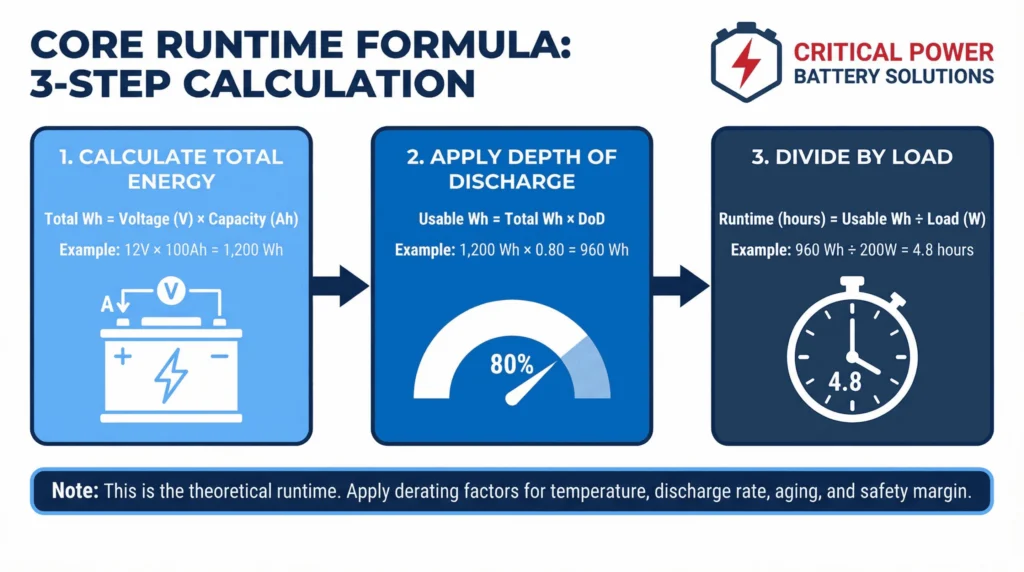
Ask your equipment company how long each battery lasts at your child’s settings. Battery age, cold weather, and extra devices can shorten run time. For a battery power station, use this simple formula. Run time in hours equals usable watt-hours divided by total watts used.
Here is a learning example. A 500 watt-hour station may give about 400 usable watt-hours after losses. Devices that draw 40 watts together would run about 10 hours.
Check the label on every device you plan to run. Confirm all numbers with your equipment provider.
Build backup power in layers
The ventilator’s internal battery
External ventilator batteries, charged and rotated
A battery power station or uninterruptible power supply sized for your total load
A portable generator, used outdoors only, with fuel stored safely
A safe place to go outside the outage area, plus a plan to move your equipment
Before you buy anything, ask your equipment company which power sources your child’s device accepts. Some devices need clean power from a pure sine wave inverter.
Generator safety rules
Use generators only outside, at least 20 feet from doors, windows, and vents
Never plug a generator into a wall outlet to power house wiring
Turn the generator off and let it cool 15 to 20 minutes before refueling
Place battery-powered carbon monoxide detectors near every sleeping area
Buy fuel and test the generator before storm season
Tell the people who will respond
Call your local fire department or EMS non-emergency line. Ask how to register a medically fragile child at your address. Share your written plan with yourpediatric skilled nursing team and backup caregivers. Know who does what on your team. Our guide explains the roles ofRNs, LPNs, and CNAs under GAPP.
Georgia faces winter ice storms and a hurricane season from June through November. Review your plan twice a year. Cold and flu season adds risk too, so read ourRSV and flu season safety guide.
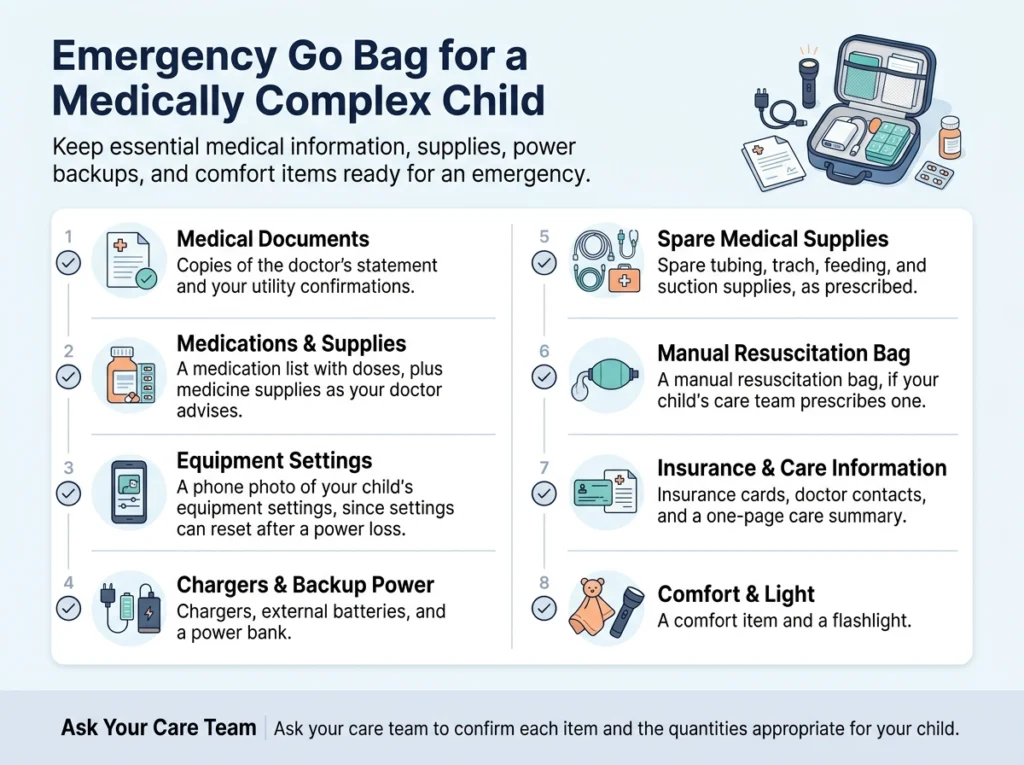
Emergency Go Bag for a Medically Complex Child
A go bag belongs in every emergency preparedness plan for a child with special needs. Keep your Georgia Power medical priority paperwork inside it. Ask your care team to confirm each item.
Copies of the doctor’s statement and your utility confirmations
A medication list with doses, plus medicine supplies as your doctor advises
A phone photo of your child’s equipment settings, since settings can reset after a power loss
Chargers, external batteries, and a power bank
Spare tubing, trach, feeding, and suction supplies, as prescribed
A manual resuscitation bag, if your child’s care team prescribes one
Insurance cards, doctor contacts, and a one-page care summary
The PSC rule lists no fee for Georgia Power medical priority shutoff protection. Your doctor’s office may charge to complete forms. Ask before you book.
Cost of backup power
Prices change often, so check current listings. Listings we reviewed showed small battery stations near $200 and 1,000 watt-hour units from about $400 to $500. Portable generators for home backup often ran about $500 to $1,500 before electrical work.
Recharge time and a way to recharge during an outage
Indoor use, which favors battery stations over fuel generators
Fuel storage, noise, and upkeep for generators
Fit with your child’s specific device
Common Mistakes to Avoid
Waiting for a storm warning to start paperwork
Missing the 10-day deadline for the doctor’s statement
Assuming Georgia Power medical priority rules also apply to small utilities
Running a generator in a garage or near a window
Never testing batteries after a long storm
Emergency planning can wear you down. Learn the signs ofcaregiver burnout, and see howrespite care can give you a break.
Why Choose Care Within Reach
Care Within Reach supports children and families across Georgia with home-based skilled nursing and personal care services. Our team helps families understand the care process, prepare the necessary information, and receive support that meets the child’s daily medical needs.
Families choose Care Within Reach because of our:
Experienced pediatric nursing support
Understanding of GAAP and Medicaid requirements
Personalized care plans based on each child’s needs
Clear communication with families and care teams
Respectful, family-centered support at home
Our goal is to help children with medical needs receive safe, consistent care at home while guiding families throughout the process.
Conclusion
Start with one call to your electric provider about your shutoff rights. Then ask your child’s doctor for the written statement. Build your backup power layers and go bag as the paperwork moves.
1. Does Georgia Power have a medical priority program?
We found no published Georgia Power medical priority program that guarantees faster power restoration. Georgia rules do protect seriously ill customers from shutoff for unpaid bills. Call Georgia Power and ask what medical notes it adds to accounts.
2. How do I sign up for Georgia Power medical priority protection?
Tell your utility that your child has a serious illness. Then send a written statement from a doctor, health board, hospital, or clinic within 10 days. Keep dated copies of everything you send.
3. What must the doctor write for Georgia Power medical priority?
The statement must name the illness and its expected length. It must also say that losing electric service would make the illness worse. Ask the doctor to list your child’s equipment too.
4. How long does Georgia Power medical priority shutoff protection last?
The hold lasts for the shorter of two periods. These are the length of the illness or one month from your first notice. You can renew once by repeating the process.
5. Does Georgia Power medical priority apply to EMC and city utility customers?
Not necessarily. Reports say the state rule does not cover Georgia’s nearly 100 small utilities. Ask your provider for its written policy, and watch House Bill 641 for changes.



Leave A Comment